Adding a Background Page in Visio

This question came from a colleague looking to add "icons and stuff" to a Visio diagram.

I believe in applying CMS principles to your CMS designs, so use these quick four steps to create and use a background in your Visio diagrams.


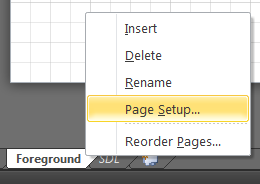
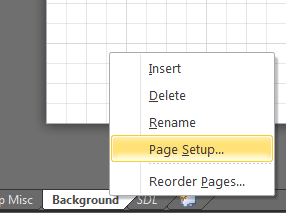
1. Right-click a tab and go to Page Setup...

2. Set this tab as a Background. I typically call it something like Background or my company name.

3. Then for each page that should use this background, also go to Page Setup...

4. Set the Background for your tab.
Going forward, updates to your background will apply to each page. The only issue I've had with this is mismatched pages tend to move the background elements.


If perfect is the enemy of good, what does 100% mean?

The perfect is the enemy of good. Here are some stories of the pursuit of Web, writing, grades, and Tridion sharing "perfection" and its unintended consequences (in Pixar Prompt format).

Once Upon a Web Development Time

Once upon a time there was a Web development team. Every week, the business analyst checked the site for broken links. One day the team wanted perfect error logs. Because of that, the team redirected all 404 page-not-found errors to the homepage. Because of that, the BA stopped finding broken links. Until finally the team brought the 404 page back to properly monitor broken links.
In a past role I was in charge of basic Web Business Analysis tasks which included everything from requirements to reporting. I used tools like Webtrends and SortSite to report on my company's sites. The development team also used ELMAH to find and track errors.

Over time we were able to track, fix, and reduce errors across sites but pesky 404 (page not found) errors kept coming up on the corporate site. These could be from out-dated bookmarks, typos, or occasionally when I entered a url that ended with /alvin-says-hi.aspx.

But one day we achieved 404 perfection. My link checking tests reported no broken links. Suspiciously this included pages meant to return a 404.

To "fix" the 404s, apparently we redirected all 404 errors to the homepage.

Oops.

Did that sink in yet? This meant for awhile that:

  • The site could have an unlimited number of broken links that would never show up tools meant to detect broken links
  • Web analytics might still report bad links that we actually visited, though (if someone looked for it)
  • Issues linking to certain pages could go undetected. Email campaigns that had a typo would still seemingly link okay to the site, even if the link should have gone to a specific page.

The team eventually brought the 404 page back so they could better monitor broken pages.

Some things can't possibly be 100% 100% of the time. You can't improve if you don't honestly measure.

Btw, I should plug the fact that SDL offers SDL Safeguard, a comprehensive site quality/brand/compliance checking solution.

Don't Measure the Small Stuff

Once upon a time there was a proposal writing team that answered RFPs. Every day the manager reviewed proposals for spelling errors. One day she found five errors. Because of that, she sent the proposal back. Because of that, the writer fixed it. Until finally the team (mostly) never worried about spelling errors again.
BSMSO has an approach for things that should be 100%. When reviewing a proposal, if it hits a certain number of errors, she kindly asks for another review. She doesn't need to maintain a list of "proposals with 100% correct spelling." When excellence is expected and typically delivered, you don't need to nitpick the fact something was less than perfect. You fix it and move on.

There's no need to measure the small stuff and if they did, the tedium for professional writers would either impact morale or slow the process down. You don't need to measure the things that don't need to be improved.

100% Might Be Too Small

Once upon a time there was a student. Every day, she got good grades. One day she got a less-than-perfect score. Because of that, she realized what she could improve on. Because of that, she worked on what she was good at while fixing the things she was bad at. Until finally "100%" held no sway over her.
Although school taught us to aim for 100%, you can't learn to be better if you always get perfect marks. "You're at 100% and doing everything expected of you" doesn't confirm what your impact is, what you could achieve, or what you could work on (or ignore to focus on the things you're really good at). Set your bar too low and people may miss their true potential.

The Cost of Winning

Once upon a time there was a Tridion consultant. Every day, he asked and answered Tridion questions privately among his peers. One day he decided to try for the sharing award. Because of that, he shared very much. Because of that, he won an award. Until finally...
I'm on the selection panel of an uber geek award for Tridion sharing. The impact of "100%" on this program is similar to that moment at the end of the school year after a big exam. In the last nights of cramming for the test maybe you promise you'll go back and really learn the material. Or maybe you'll send in the extra credit assignments to guarantee a certain grade.

What really happens is you finish the big exam, your mind starts to slowly forget very-important-facts-now-turned-trivia, and you go off to do something more interesting.

So by offering a known award with supposedly clear criteria, we've created an extrinsic award when we really want intrinsic motivation. Watch or read Paniel Pink to get the difference.

This suggests my attempts to encourage you to share should focus on the parts of sharing that appeal to you most. I know it's not time, because I see you on Facebook and Skype. :-)  You can't claim a lack of topics because there's always a topic in your email, in recent code you've written, as a section of the documentation, or from a growing list of questions.

Tip for those trying to win any award: know why you're starting in the first place. If your target (e.g. win a community sharing award) is your incentive, then you'll likely reach it. But there's a chance you won't have the drive in subsequent contests or years. Interests change over time for sure, but some longevity demonstrates you're in it for causes larger than yourself.

If "100%" has no away for you, if you're compelled to learn, excel, and to give back then you will win awards, the appreciation of others, and maybe eventually you'll start shaping the communities you chose to join.

So how do we end this story? "Because of that, he won an award. Until finally..."

  • He paid the price of 100% and stopped sharing as much because he reached his goal. Or...
  • He encouraged others to share. Or...
  • He changed the community itself.
Don't let 100% nor perfection distract you from improving or recognizing what you're already great at.

SDL Tridion 2013 SP1 is Out

And after seeing at least four internal presentations, chatting with colleagues, and attending full-day knowledge sharing session on SDL Tridion 2013 SP1, I'm not sure where to begin or what to share.

So first, be sure to congratulate the team (and this guy on his first release) and dive into the documentation when ready. Btw, that Tridion documentation you're reading uses another SDL product.

So instead, here's my personal To Do list based on the update. See if you can tell which task is related to what part of the update.

  • Update my use of Tridion-related icons (going forward)
  • Reconsider my advice for Custom Pages considering an even better way to integrate
  • Research "easy-to-setup CMIS-compliant CMS"
  • Revisit TridionStack exchange questions on configuring Experience Manager-enabled sites in the dashboard, workflow, and setting item publish status
  • Find my instance where I set up Target Groups (or set them up again)
  • Make the "Insight" part of SDL's Customer Experience Management story concrete
  • Find the right contacts to try other SDL products
  • Review Education exercises for workflow and workflow design
  • Revisit the component synchronizer
  • Explain the Ambient Data Framework and Context Engine in a business-friendly way
  • Suggest new new BluePrinting best practices for contextual templating
  • Double-check which of my SDL Tridion Ideas made it into the product!
Also, if you're wondering if it's too late to be considered for the SDL Tridion MVP 2014 evaluations, first read Bart Koopman's post and then consider sharing something we didn't know about Tridion (because it's new).

For a list of potential topics and material, just look at what you've recently presented on or read a post by Chris Morgan for an SDL Tridion 2013 SP1 overview (and I thought I was fast).


SDL Media Manager Bootcamp

I'm back from yet another bootcamp session in Amsterdam, this time for SDL Media Manager. Big thanks to the company and my European colleagues for bringing us across the "pond" to learn and share about SDL Media Manager.
My first exposure to a "Bootcamp" session was back in 2011 as a privileged customer having won an award for sharing stuff about Tridion. Since then (or maybe because the session convinced me), I've joined SDL and then had a few opportunities to participate in internal knowledge sharing sessions, a user day event, community award summits, and an Experience Manager (then "New UI") bootcamp (also in Amsterdam). These have all been great sessions where I learn as much from my fellow (often remote) colleagues as I do about software. 
Tip: if these time of sessions interest you, definitely reach out to your local representative, field marketer, or even product management (many are quite visible in our technical community).

Here are my three main "aha" moments from the four days of sessions.

  1. Lessons Learned from SDL Media Manager
  2. SDL Tridion influencing SDL Media Manager
  3. Next Steps in the Community

Lessons Learned from SDL Media Manager

SDL Media Manager is Refining my Perspective on SDL Tridion and CMS

Fellow Tridionaut (SDL Tridion community member) Frank Taylor describes SDL Media Manager (and nitpicks some of its UI). I actually love the Manage, Assemble, and Distribute sections. This reads as "1, 2, 3..." to CMS users, whereas SDL Tridion BluePrinting, at least in the Content Manager Explorer, has a standard "folder, folder, another folder..." approach.
"Would you also like to..." If you look at SDL Tridion Experience manager, making a page has a wizard-like "1, 2, 3..." process. I'm definitely for good defaults and a process that guides and nudges users, while still giving them flexibility.
I've already submitted an SDL Tridion Idea to add more of this good stuff (go vote for it!). Imagine if after creating a schema you got prompted to make or choose a template, then maybe start a test component and even a layout TBB for the template?
Out-of-the-box and standardized content model.

I'm fascinated by SDL Media Manager's set of known and supported default "content types." If you're an avid SDL Tridion blogosphere reader, you will notice schema.org mentioned on at least two other blogs (bonus points if you know which two). Schema.org suggests an "industry standard" for content types (schemas) which can translate into easier SDL Tridion implementations (in addition to starting code toolkits, we could lead with known content types).

When I engage SDL Tridion customers from a functional design perspective, it seems everyone is fairly ready to code, but many are new to modeling content relationships. On the media asset side, though, everyone seems to understand mime types or the idea of a Media player.

Cloud. Yes, with its multi-tiered, Web-based architecture, SDL Tridion can fly, but SDL Media Manager is already in the cloud.

My SDL Tridion 2013 VM guide (and Nuno Linhares's original version for 2011 that it was based on) must be really popular because everyone seems to have their own Tridion virtual machine or instance. :-) Being surrounded by Tridion experts means it's trivial to spawn off "Fifth Environments" anytime for any project. This is great for the community since everyone can independently learn (while breaking their own systems) and we get so many contributions. For example, search for Tridion navigation to get a flavor of options. I love the flexibility, but I can only support so many Sixth (Custom) Environments.

As I get access to internal PS-supported implementations, I'm going to ask my WCM colleagues "can we just do it like Media Manager?" Give me one cloud environment and let me create a consolidated, yet flexible content model. Then code whatever you want on top of it. :-)

I might tease you for saying you work for Tridion (hint: no one does), but the point is these learning sessions, implementations, and the integration between the two systems means the products and people will continue to influence each other.

SDL Tridion Influencing SDL Media Manager 

Key-Value Custom Events. SDL Media Manager has a very familiar feature called Custom Events (not to be confused with Events in Tridion) that lets authors add key-value pairs to customize the behavior of things like media players. In Tridion we might make a "configuration" or labels component to implement something similar.

It's flexible (and out-of-the-box) in Media Manager but I'd imagine authors wanting pre-selected keys or configurable sets like "intro," "credits," or "chapters." We'll see how the Media Asset Management system evolves. One great feature is the ability to upload an Events File in lieu of such Custom Events--this would be my functional hook to give authors a way to choose functionality over entering text values.

BluePrinting-friendly! I need to investigate further but simply referencing a video from SDL Tridion will get you the deliver-side translated version (assuming the video has translated transcripts). You wouldn't need to go to each publication to localize or wire the video. The only catch is previewing the video in the CME may not detect the right language (in the context of Tridion you're using your langauge), however viewing in Staging will work fine based on the Staging site's language.

Templating. "SDL Tridion is sophisticated to meet customer's sophisticated needs" (yeah, some of my customers scoff at my view). Part of that sophistication is a very flexible approach to delivery which is basically, "anything you want."

I've gotten stuck in circular discussion on the output format from Tridion that sound like:
"What {JSON|XML|HTML|JSP\ASPX} output do you deliver?"
"Nearly anything you can define. What do you need?"
"We need the output to be {JSON|XML|HTML|JSP\ASPX}." :-|
SDL Tridion customers want or need everything from URLs, to fragments or snippets of markup (component presentations in Tridion terminology), to complete HTML 5 video players. The "page" format could be JSON, XML, or some proprietary format.

But since Tridion can do rendering in templating at publish or let you manipulate the content model in delivery (in an MVC-type approach), Tridion can easily consume whatever SDL Media Manager distributions output.

My main concerns for templating with Media Manager are:
  • We only get one Schema for all of Media Manager's outlets and channels. So we'll have to be a little creative when approaching region-driven functionality (mainly through folder structure, metadata, and of course page types).
  • Only some of Media Manager's (external-to-Tridion) metadata is exposed through the ECL Provider. The team discussed possibilities of opening this up in the future.

Next Steps in the (Joint) Community

I submitted another SDL Tridion Idea to standardize a way to map items, hoping we could get us to a place where anyone could "right-click > try this in my environment."

It's a great time for SDL Media Manager and SDL Tridion. I'm looking forward to sharing the SDL Media Manager insights and examples with my peers at the next internal SDL Tridion knowledge sharing. Follow #SDLMedia as well as #SDLTridion for updates if you haven't noticed #media-manager questions on Tridion Stack Exchange already.

Bart Koopman has already released a few Media Manager and ECL-related extensions on SDL Tridion World. Our community has joked about what googling Tridion problems was like in 2008 (hint: hindsight makes it humorous... now), but this is 2013. Have you seen the number of GitHub Tridion repositories lately? There are (as I type this) 1,222 Tridion Stack Exchange Questions. SDL Media Manger (at least as they relate to SDL Tridion) examples will fit right in our growing community.

So now what?
  • Stay tuned for community contributions, examples, and new SDL Tridion + SDL Media Manager/ECL practices.
  • For SDL Tridion partners and customers that can't wait, find your nearest representative, ping me online, or reach out to product management to learn more about such bootcamp events or SDL Media Manager. Try joining SDL Tridion Pulse (and ping @Davina).
  • Ask Education about formal courses.
  • Share more. Or share for the first time.
The upcoming SDL Tridion + SDL Media Manager examples will be a mix of markup, CSS, multimedia, and JQuery skills with a tiny bit of SDL Tridion and whole lot of SDL Media Manager goodness. It's a great opportunity to flex your front-end design skills.